

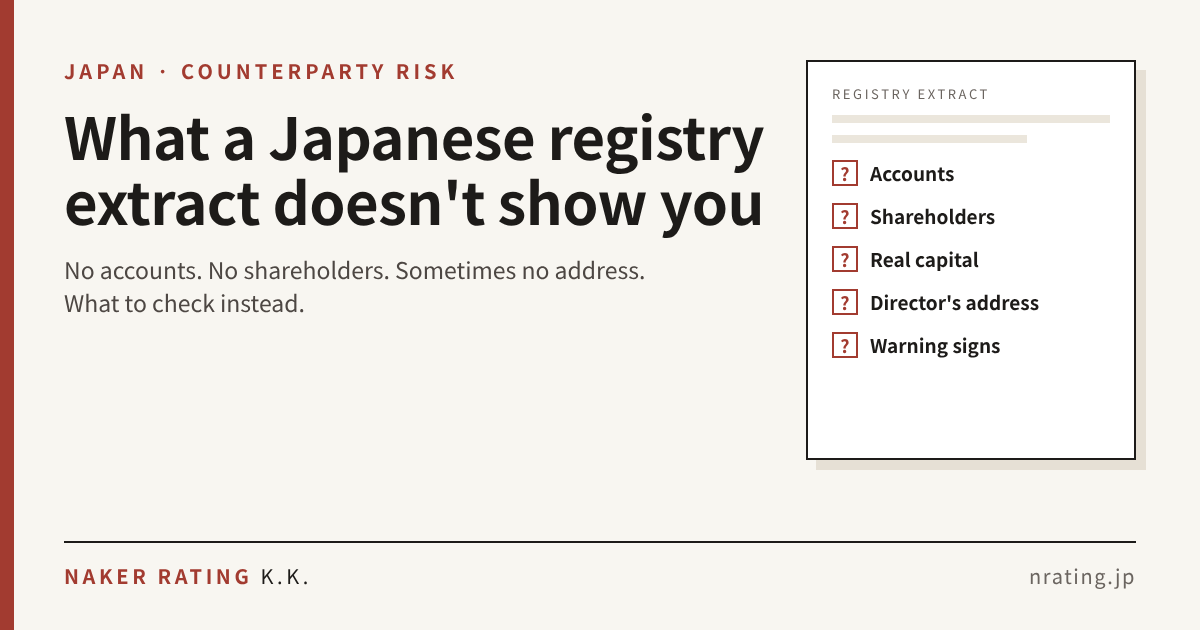
- 1What the registry provesThat a Japanese company exists, where it is registered and who runs it
- 2What it does not showIts accounts, its owners or its problems
- 3Financial statementsMany private companies publish no usable accounts, and some do not publish even the balance sheet the law requires. Estimated financial statements (NRMFS) still give reference figures
- 4Beneficial ownershipLodged only on the company’s own application and not open to creditors
- 5Weaker evidence than it looksThe capital figure, and since October 2024 the representative’s address
- 6What to doFor any meaningful exposure, combine public checks with an investigation on the ground
Japan has a reputation that works in its favour in a credit file. Contracts are honoured, invoices are paid on the due date, and a Japanese counterparty is often treated as low risk before anyone has looked at it. For a credit manager in Singapore, Frankfurt or Chicago, the usual first step is an extract from the Japanese commercial registry, or a one-page summary built on it.
That extract is a useful document. On its own, it is close to useless for a credit decision. This article explains why, and what to check instead.
What the registry does record
The commercial registry, kept by the Legal Affairs Bureaus of the Ministry of Justice, records a company’s trade name, head office, business purpose, paid-in capital, date of incorporation, directors and representative director, and the history of changes to these items.
Every company also has a 13-digit corporate number issued by the National Tax Agency. The Agency’s Corporate Number Publication Site, which has an English interface, lets anyone confirm a company’s name, address and number, and the history of name and address changes, free of charge.
So you can confirm that the company exists, where it is registered and who runs it. That is identity, not credit.
Gap 1: no financial statements
Unlike the UK’s Companies House or many European registries, the Japanese registry holds no accounts. Private companies do not file financial statements with any public body that a creditor can search.
The law does require them to publish something. Article 440 of the Companies Act obliges a stock company (kabushiki kaisha) to publish its balance sheet after each annual general meeting, and a large company (capital of JPY 500 million or more, or liabilities of JPY 20 billion or more) its profit and loss statement as well. Companies that file annual securities reports, which includes listed companies, are exempt, as are the older yugen kaisha form and partnership-type companies such as the godo kaisha. The penalty for not publishing is a non-criminal fine of up to JPY 1 million, imposed on the directors.
In practice, some private companies do not publish even the balance sheet. Where one has been published, it is usually a summarised balance sheet, and for a company below the large-company threshold there is no profit figure at all.
For a typical Japanese small or mid-sized company, then, the published numbers are thin or missing. That does not mean you have to decide blind, but it does mean the figures have to come from somewhere other than the registry.
Gap 2: no shareholders
The registry does not list shareholders. A company’s owners appear in its own share register, which an outside creditor has no right to inspect.
Since 31 January 2022 Japan has had a beneficial ownership list system: a stock company can lodge a statement of its beneficial owners with the Legal Affairs Bureau. But the system starts only on the company’s own application, and copies are issued to the company. A foreign creditor cannot pull the list. It sees it only if the company chooses to hand it over.
For sanctions and export-control compliance this matters. You may screen the company name and its directors and never see who owns it.
Gap 3: the capital figure means little
Japan abolished the minimum capital requirement for stock companies in the 2006 company law reform. A kabushiki kaisha can be incorporated with paid-in capital of one yen. Capital of JPY 5 million or JPY 10 million is common, but it is a registration figure, not net worth, and it says nothing about whether losses have since eaten it.
Gap 4: the representative’s address may no longer be shown
Since 1 October 2024 a stock company can ask for its representative director’s home address to be shown on the registry only down to the city or ward. It is a reasonable privacy measure. It also removes one of the few cross-checks a registry offered: whether the registered office is, in fact, the director’s home.
Gap 5: no warning of trouble
Nothing in a registry extract tells you that a company is paying its suppliers late, that a subsidiary has been prosecuted, or that its reported turnover has stayed at the same round number for four years. Those facts come from the Official Gazette, where insolvency notices are published, from court and regulatory records, from the press, and from direct enquiry.
What to check instead
A practical sequence for a new Japanese counterparty:
- Confirm identity on the corporate number site. Exact Japanese name, address, number, and any recent change of name or address.
- Obtain a registry extract with history. Look at recent changes: a new representative director, office moves, a change of business purpose, a capital reduction. Several changes in a short period deserve a question.
- Search the Official Gazette for insolvency notices and for any published balance sheet.
- Ask for financial statements. A refusal is not a red flag on its own in Japan, where many small companies do not share their accounts, but it should change your terms.
- Screen the company, its directors and any known owners against sanctions and export-control lists, and keep the result even when it is “no record found”.
- If the exposure matters, commission an investigation by someone on the ground in Japan who can read the Japanese documents, make the calls and check the address.
How we help
Naker Rating K.K. investigates Japanese companies for credit managers, trade-credit insurers and credit-reporting agencies outside Japan. Our reports are written in English and include a five-grade credit rating (NRating), an estimated default probability, a credit limit (NR Credit Limit), watchpoints, litigation and adverse-record checks, and sanctions and export-control screening. When a company publishes no accounts at all, not even the balance sheet the law requires, we prepare NRMFS, our estimated financial statements, so you still have reference figures for the company’s size, net worth and leverage, together with a rating (NRating) and a credit limit (NR Credit Limit).
You can see what that looks like in two actual reports, de-identified: a 28-page Standard report on a listed company and a 3-page Short report on a small private exporter.
Download the sample pack (PDF) | Order a report by email | Ask about a Japanese company
Summary
- The registry proves that a Japanese company exists. It does not show its accounts, its owners or its problems.
- Many private companies publish no usable financial statements, and some do not publish even the balance sheet the law requires.
- Where there are no accounts, estimated financial statements (NRMFS) still give you reference figures for a credit decision.
- Beneficial ownership information is lodged only on the company’s own application and is not open to creditors.
- The capital figure, and since October 2024 the representative’s address, are weaker evidence than they look.
- For any meaningful exposure, combine the public checks above with an investigation on the ground.
Sources
- Ministry of Justice, beneficial ownership list system (実質的支配者リスト制度): https://www.moj.go.jp/MINJI/minji06_00116.html
- Ministry of Justice, non-display of representative directors’ addresses from 1 October 2024 (代表取締役等住所非表示措置): https://www.moj.go.jp/MINJI/minji06_00210.html
- National Tax Agency, Corporate Number Publication Site (English): https://www.houjin-bangou.nta.go.jp/en/
- Companies Act, Article 440 (public notice of financial statements) and Article 976 (non-criminal fines): https://laws.e-gov.go.jp/law/417AC0000000086


8 thoughts on “Why a Japanese company registry extract tells you almost nothing about credit risk”