

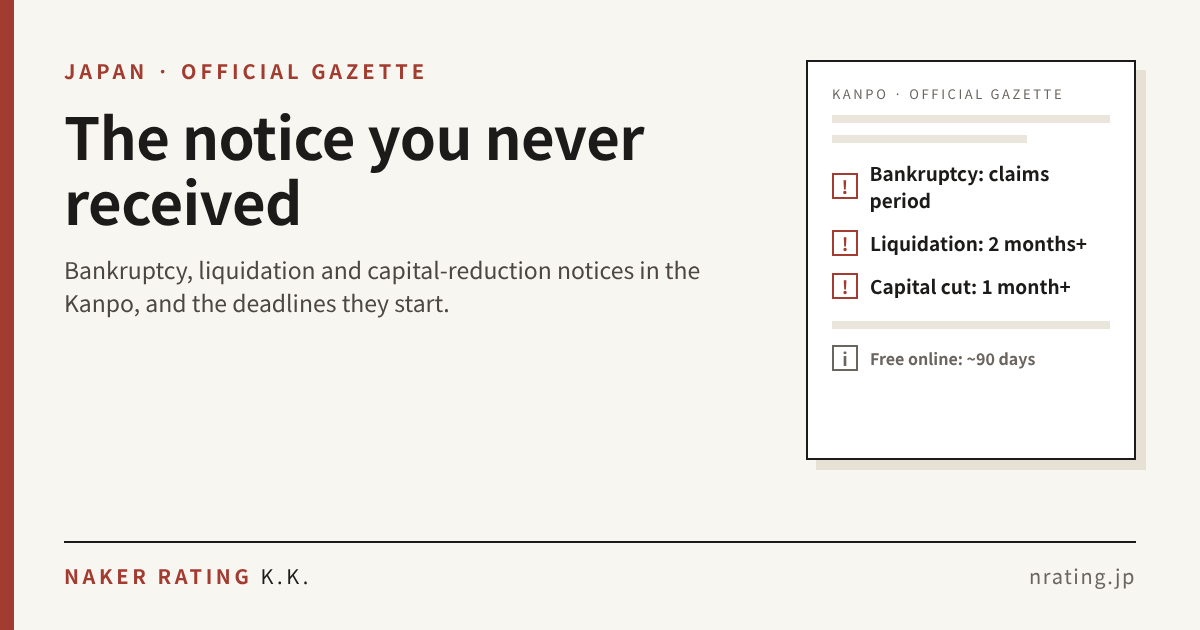
- 1What the Kanpo isJapan’s Official Gazette, where bankruptcy, liquidation, capital-reduction and merger notices are published. Japanese only; free online for about 90 days
- 2BankruptcyThe court fixes a claims-filing period
- 3LiquidationCreditors have at least two months to file
- 4Capital reductionCreditors have at least one month to object
- 5The riskYou may receive no letter: in liquidation if the company does not know you, and in a capital reduction if it also publishes the notice elsewhere
- 6What to doThe Gazette reports events after they happen. Assess Japanese customers before that point, with estimated figures where no accounts exist
When a Japanese company goes bankrupt, starts liquidation or cuts its capital, the law requires a public notice. That notice appears in the Kanpo, Japan’s Official Gazette. For a creditor outside Japan, it is often the first written sign that something has changed at a Japanese customer, and it usually starts a deadline.
The Kanpo is also easy to miss. It is published in Japanese only, every business day, and most foreign credit teams never look at it. This article explains which notices matter to a trade creditor, what deadlines they set, and what the Gazette will not tell you.
What the Kanpo is
The Kanpo is the official publication in which Japan’s government publishes laws and official notices, and in which companies and courts publish the notices that the law requires. Since 1 April 2025 it has been published electronically: the edition posted on the government’s official gazette website is the official one. Each issue can be read and downloaded free of charge on that site for, in principle, 90 days after publication.
That 90-day window matters. If nobody in your team looks within three months, the free trail goes cold.
Notice 1: bankruptcy
When a Japanese court opens bankruptcy proceedings, it appoints a trustee and, at the same time, fixes a period for filing bankruptcy claims, the date of the first creditors’ meeting and the period for examining claims. The commencement is then published in the Kanpo.
For a foreign creditor, the key line is the claims-filing period. The notice names the court, the case and the trustee. File within the period stated, through the trustee’s office, and keep proof of what you sent. If your contract or invoices are in English, expect to be asked for Japanese explanations of the claim.
Notice 2: dissolution and liquidation
A company that is wound up voluntarily must, without delay, publish a notice in the Kanpo calling on its creditors to file their claims within a set period. That period cannot be shorter than two months. The company must also notify each creditor it knows of individually.
Two practical points follow. First, “known creditors” receive a letter, but if you sold through an agent or a trading company, the liquidator may not know you, and the Gazette notice may be the only notice you get. Second, a voluntary liquidation is not necessarily an insolvency. Many are orderly closures of solvent companies. The notice tells you that the company is ending, not whether you will be paid.
Notice 3: capital reduction
When a stock company reduces its capital, its creditors have a right to object. The company must publish in the Kanpo the content of the reduction, information on its financial statements and the fact that creditors may object within a set period, which cannot be shorter than one month. It must also notify known creditors individually, unless it publishes the notice in a daily newspaper or by electronic public notice as well. In that case it can skip the individual letters.
In other words, a Japanese customer can cut its capital without ever writing to you. A capital reduction is not always a warning sign; it is sometimes done for tax or restructuring reasons. But it is worth a question, especially when it comes with losses. Mergers and company splits follow a similar creditor-objection procedure.
Notice 4: published balance sheets
As we explained in our earlier article, Why a Japanese company registry extract tells you almost nothing about credit risk, stock companies are required to publish a balance sheet each year, and many companies that do publish use the Kanpo. If your customer has published one, it is in the Gazette. If it has not, that absence is itself information.
What the Kanpo does not tell you
- Anything before the event. A bankruptcy notice appears after the court has acted. Late payments, unpaid suppliers and a stretched bank position never appear in the Gazette.
- Anything in English. Every notice is in Japanese, and names are written as registered. A company known abroad by an English name may appear under a Japanese name you do not recognise.
- Whether you will be paid. A liquidation notice does not say whether the company is solvent, and a bankruptcy notice does not say what creditors will recover.
- Anything after 90 days, free. Notices remain official, but the free full-text window on the official site closes.
A simple routine for Japanese counterparties
- Record each Japanese customer’s exact Japanese name, address and corporate number. You will need them to recognise a notice.
- Check the Gazette at least as often as your shortest payment term, or ask someone who reads Japanese to do it.
- When a notice appears, diarise the deadline at once: claims filing in bankruptcy, claims filing in liquidation, objection in a capital reduction or merger.
- Stop shipping on open account to a customer under bankruptcy or liquidation until you have reviewed the position.
- Do not wait for the Gazette. For any customer you cannot afford to lose, get a full picture before the event: accounts or, where there are none, estimated figures; payment behaviour; litigation; and sanctions and export-control screening.
How we help
Naker Rating K.K. investigates Japanese companies for credit managers, trade-credit insurers and credit-reporting agencies outside Japan. Our English-language reports check registry history, official notices and court and regulatory records, and give a five-grade credit rating (NRating), an estimated default probability and a credit limit (NR Credit Limit). When a company publishes no accounts at all, our reports include NRMFS, our estimated financial statements, so you still have reference figures for the company’s size, net worth and leverage.
We can also watch the Kanpo for you. If you want notices about your Japanese customers picked up as they appear, rather than found after the deadline has passed, ask us.
You can see two actual reports, de-identified, in our sample pack.
Download the sample pack (PDF) | Order a report by email | Ask about a Japanese company
Summary
- The Kanpo is where Japanese bankruptcy, liquidation, capital-reduction and merger notices are published. It is in Japanese and free online for about 90 days.
- In bankruptcy, the court fixes a claims-filing period; in liquidation, creditors have at least two months to file; in a capital reduction, at least one month to object.
- You may receive no letter: in liquidation if the company does not know you, and in a capital reduction if it also publishes the notice elsewhere.
- The Gazette reports events after they happen. Assess Japanese customers before that point, with estimated figures where no accounts exist.
Sources
- Cabinet Office, electronic Official Gazette from 1 April 2025 (官報の電子化): https://www.cao.go.jp/others/soumu/kanpo/about/kanpo_about.html
- Bankruptcy Act, Article 31 (matters fixed on commencement) and Article 32 (public notice of commencement) (破産法第31条・第32条)
- Companies Act, Article 449 (creditor objection on capital reduction) and Article 499 (notice to creditors in liquidation) (会社法第449条・第499条): https://laws.e-gov.go.jp/law/417AC0000000086

One thought on “Reading the Kanpo: what Japan’s Official Gazette tells a foreign creditor, and what it doesn’t”