
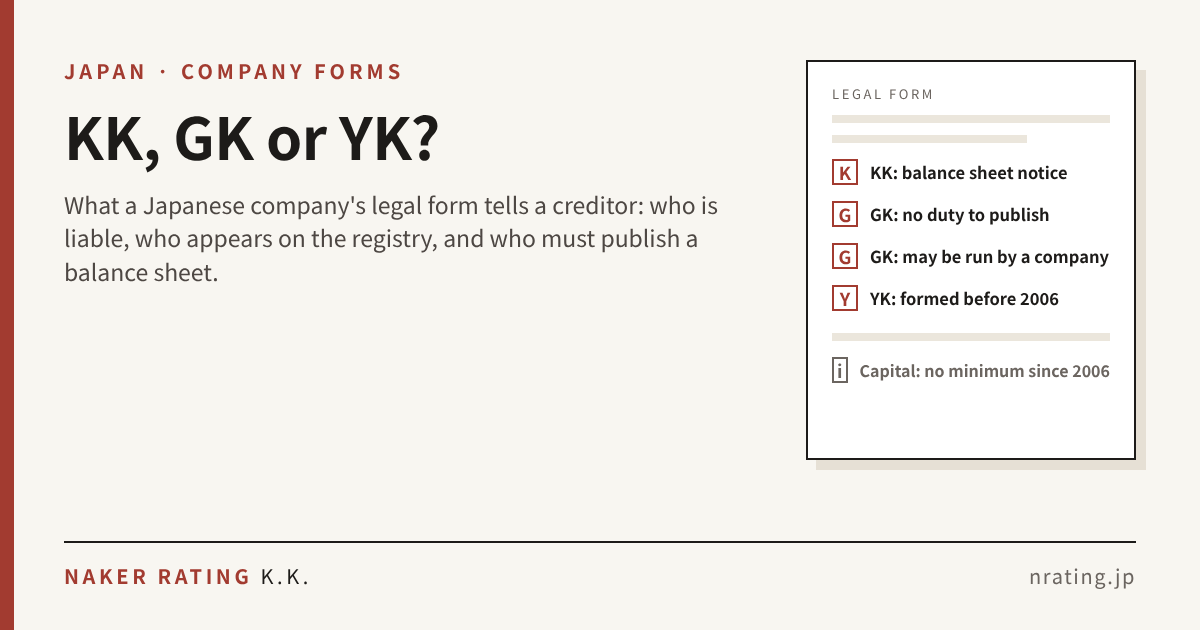
- 1The suffix is a rulebookWhether a Japanese company is a kabushiki kaisha, a godo kaisha or a yugen kaisha decides what it must disclose and who appears on the registry.
- 2Only KKs must publish a balance sheetA stock company must publish its balance sheet each year, though most do not. A godo kaisha and a yugen kaisha have no such duty.
- 3A GK’s representative may be a companyThe registry then names a corporate member and the individual who acts for it, so you may need to look one level up.
- 4Yugen kaisha means pre-2006No new yugen kaisha has been formed since May 2006, so the name tells you the company’s roots are at least that old.
- 5Capital tells you littleJapan has had no minimum capital since 2006. A company can be formed with one yen.
- 6Liability is limited in all threeOwners are not liable for the company’s debts. Look at the company’s own strength, or ask for a guarantee.
A Japanese company name carries a short word that most foreign credit teams skip: kabushiki kaisha, godo kaisha or yugen kaisha. It is easy to treat it like “Ltd.” or “Inc.” But in Japan the legal form decides what a company must disclose, who appears on the registry and what you can expect to find before you extend credit.
This article explains the forms you will meet most often and what each one tells a creditor.
The forms you will meet
- Kabushiki kaisha (株式会社, KK): a stock company. This is the most common form, from one-person businesses to the largest listed groups.
- Godo kaisha (合同会社, GK): a membership company with limited liability, introduced in 2006 and often compared to a US LLC. It is used by small businesses and also by the Japanese subsidiaries of some large foreign groups.
- Yugen kaisha (有限会社, YK): a limited company formed under the old law. Since May 2006 none can be formed, but existing ones continue as a special kind of stock company and must keep “yugen kaisha” in their name.
- Gomei kaisha (合名会社) and goshi kaisha (合資会社): partnership-type companies in which some or all members have unlimited liability. They are rare in trade.
Kabushiki kaisha: the only form that must publish a balance sheet
Under the Companies Act, a stock company must publish its balance sheet after each annual shareholders’ meeting. A large company, broadly one with capital of 500 million yen or more or liabilities of 20 billion yen or more, must publish its profit and loss statement as well. Listed companies that file annual securities reports are exempt, because their full accounts are already public.
In practice, most stock companies do not make this notice. Even when a company does publish, a notice in the Official Gazette or a newspaper may be only a summary of the balance sheet. It will not show sales or profit. We explained the gap in our article on the Japanese registry. Even so, for a KK the absence of a published balance sheet is itself information: the law asks for it.
Why you usually cannot get the accounts
The Companies Act does give some people a right to see a company’s accounts. A stock company must keep them at its office, and its shareholders and creditors may inspect them during business hours. A godo kaisha’s creditors have a similar right.
But a company you are only thinking of selling to owes you nothing yet. Until you have delivered goods on credit, you are not its creditor, and no law requires it to show its accounts to an outsider. Combine that with the fact that most stock companies never publish the notice the law requires, and you have the usual result: a Japanese customer whose figures you cannot see before you decide.
Godo kaisha: no duty to publish, and owners who may not appear
A godo kaisha has no obligation to publish its accounts. A creditor should expect to find nothing, and should ask for figures directly.
All members of a GK have limited liability, as shareholders of a KK do. The registry shows the members who run the business and the representative member. A member who does not run the business does not have to appear on the registry at all.
The representative member can itself be a company. In that case the registry names the corporate member and the individual appointed to act for it. For a creditor, or for anyone screening against sanctions lists, that means the person signing your contract may act for a company you have not yet looked at. Look one level up.
Yugen kaisha: an older company with no duty to publish
A yugen kaisha is legally a stock company, but the provisions requiring a stock company to publish its balance sheet do not apply to it. Like a GK, it has no duty to publish.
The name does tell you something useful. Because no yugen kaisha has been formed since May 2006, a company with that name has existed in some form for at least twenty years. Age is not creditworthiness, but it is one more fact you can confirm.
Capital tells you little
Since the Companies Act came into force in 2006, Japan has had no minimum capital. A KK or a GK can be formed with one yen. A registered capital of one million yen does not mean the company has one million yen today, and a large capital figure does not mean the money is still there. The registry tells you the capital; only the accounts tell you the net worth.
What this means in practice
- Read the legal form first. It tells you what you should be able to find.
- For a KK, look for the published balance sheet, in the Official Gazette, a newspaper or the company’s website. If there is none, ask why.
- For a GK or a YK, ask for the accounts directly. There is nothing to find in public.
- For a GK, check who the representative member is. If it is a company, find out who owns that company.
- Do not rely on registered capital as a measure of size or strength.
- Remember limited liability. In all three forms, the owners are not liable for the company’s debts. If the exposure matters, ask for a guarantee, as we described in our article on parent companies.
- If you already sell on credit, you are a creditor. Japanese company law lets creditors ask to inspect a stock company’s accounts at its office, without giving a reason, and gives a godo kaisha’s creditors a similar right. Few foreign suppliers use it, and the request has to be made in Japanese, but it exists. This is general information, not legal advice.
How we help
Naker Rating K.K. investigates Japanese companies of every legal form for credit managers, trade-credit insurers and credit-reporting agencies outside Japan. Our English-language reports set out the legal form, registered capital, officers and representative, and the history of changes on the registry. Each report gives a five-grade credit rating (NRating), an estimated default probability and a credit limit (NR Credit Limit). When a company publishes no accounts at all, as most GKs and YKs do not, our reports include NRMFS, our estimated financial statements, so you still have reference figures for its size, net worth and leverage.
If you only need to confirm that a Japanese company exists and how it is registered, our Japanese commercial registry check costs USD 10 and delivers the registry certificate itself within one business day. An English translation is available for an additional USD 5.
You can see two actual reports, de-identified, in our sample pack.
Download the sample pack (PDF) | Order a report by email | Ask about a Japanese company
Summary
- A Japanese company’s legal form decides what it must disclose and who appears on the registry.
- A kabushiki kaisha must publish its balance sheet each year; listed companies publish full accounts instead.
- A godo kaisha and a yugen kaisha have no duty to publish. Ask for figures directly.
- Shareholders and creditors can inspect a company’s accounts. A prospective supplier is not yet a creditor, so it usually cannot.
- A GK’s representative member may be a company. Look one level up.
- Capital tells you little: there has been no minimum capital since 2006.
Sources
- Companies Act, Article 440 (public notice of financial statements), Article 442 (keeping and inspection of financial statements), Article 576 (members of a godo kaisha), Article 598 (corporate managing members), Article 625 (inspection of a godo kaisha’s financial statements) and Article 914 (registration of a godo kaisha) (会社法第440条・第442条・第576条・第598条・第625条・第914条): https://laws.e-gov.go.jp/law/417AC0000000086
- Act on the Arrangement of Relevant Acts Incidental to the Enforcement of the Companies Act, Articles 2, 3 and 28 (yugen kaisha continuing as special limited companies) (会社法の施行に伴う関係法律の整備等に関する法律第2条・第3条・第28条): https://laws.e-gov.go.jp/law/417AC0000000087