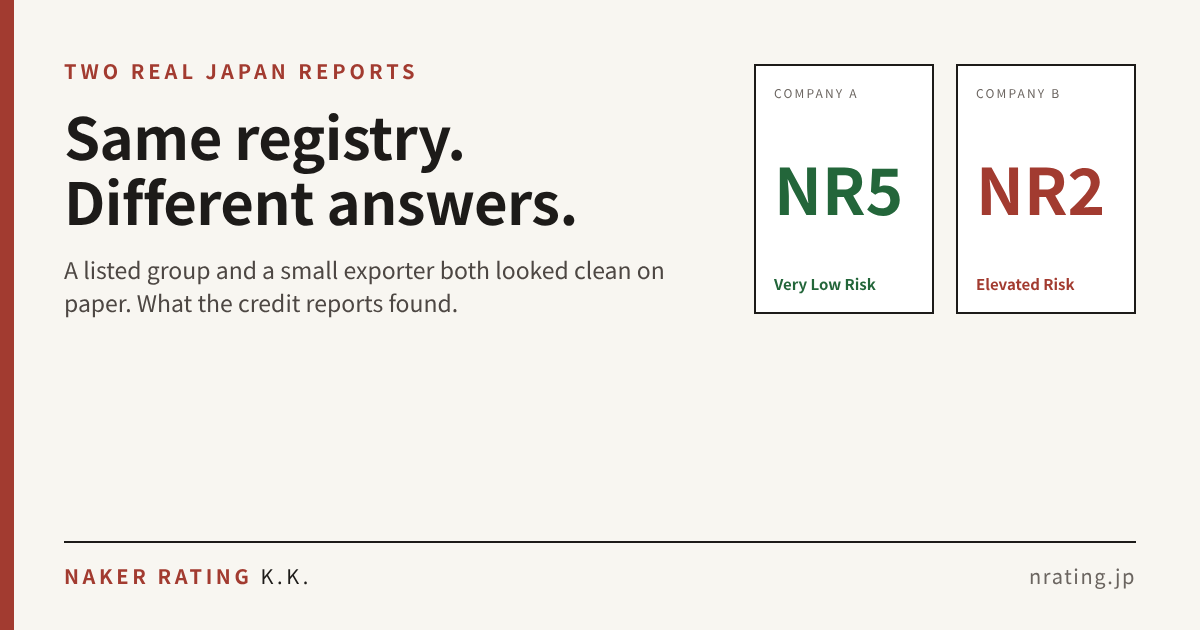
On the registry, both looked the same: active, with paid-in capital, a representative director and a registered office, and no insolvency notice.
- ESTIMATED DEFAULT PROBABILITY
- 0.3–0.8% a year
- CREDIT TERMS
- Open account up to JPY 15 million
- WHAT THE REPORT FOUND
- Seven watchpoints, including criminal prosecution of a subsidiary
- ESTIMATED DEFAULT PROBABILITY
- 5.0–7.0% a year
- CREDIT TERMS
- Open credit capped at JPY 1 million; prepaid or secured terms recommended
- WHAT THE REPORT FOUND
- No balance sheet ever published, identical turnover for four years, office at the representative’s home
Lesson: treat Japanese counterparties by size, not by country. On the registry, an honest small trader and a fragile one look the same.
Our previous article, Why a Japanese company registry extract tells you almost nothing about credit risk, explained what the registry leaves out. This one shows what that means in practice.
Two requests reached us this year from clients outside Japan. Both asked the same question about a Japanese company: can we sell to them on open account, and up to how much?
On the registry, both companies looked fine. Both were active, had paid-in capital, a representative director and a registered head office, and neither had any insolvency notice against it. The answers we gave were very different. Below is what separated them. Both reports are in our sample pack, with names and identifiers removed.
Company A: a large listed group, rated highly, with seven watchpoints
Company A is a listed energy distributor in Tokyo with consolidated revenue of several hundred billion yen, a controlling parent and an investment-grade rating from a Japanese rating agency. Its balance sheet is close to debt-free.
Our conclusion was what you would expect: NR5 (Very Low Risk), an estimated default probability of 0.3–0.8% a year, and open-account terms up to JPY 15 million per counterparty.
But the report did not stop at the grade. It raised seven watchpoints, four of them at medium level. The most serious: a wholly-owned subsidiary is facing criminal prosecution under Japan’s competition law. Others included an equity-method investment in a loss-making business, revenue that has fallen for three years in a shrinking domestic market, and one-off gains inflating the latest quarter.
None of these changed the grade, and the report explains why: the maximum fine is small against the group’s equity, the matter has not affected its funding or its external rating, and the loss-making business is held through an affiliate and shared with the parent. The report then sets out review triggers: the outcome of the trial, any administrative surcharge or suspension from public tenders, an impairment of the loss-making investment, a change in the parent’s shareholding, or a rating downgrade.
The lesson: for a large Japanese company, information is abundant. The value is in reading it, deciding what matters to a trade creditor and telling you when to look again. A one-page summary would have shown a strong company and nothing else.
Company B: a small exporter that looked normal on paper
Company B is a small private company in Kanagawa, next to Tokyo, that buys used vehicles in Japan and exports them. It has traded for about 13 years, has paid-in capital of JPY 5 million and is registered and active. On the registry there is nothing wrong.
Our conclusion: NR2 (Elevated Risk), an estimated default probability of 5.0–7.0% a year, open credit capped at JPY 1 million, and a recommendation to trade on prepaid or otherwise secured terms.
Four findings drove that result.
- No balance sheet, ever. The company has never published one, and a profit figure exists for a single year only. Net worth, gearing and liquidity cannot be verified.
- Turnover at an identical figure for four consecutive years. After rising quickly, reported turnover stayed at exactly the same round number for four years. That pattern is more consistent with a figure carried forward than with annual accounts.
- The registered office is the representative’s own residential address. There is no company website and no published landline.
- Very small scale. Capital is thin, headcount appears minimal and ownership is not on public record.
None of this is illegal, and plenty of honest small traders look like this. That is the point: on the registry, an honest small trader and a fragile one look the same. The difference shows up only when someone checks the figures, the address and the history.
No balance sheet does not have to mean no numbers. Where a Japanese company publishes no accounts, our reports, Short as well as Standard, can include NRMFS, our estimated financial statements. They give you reference figures for the company’s size, net worth and leverage, so a decision on a company like this one does not rest on the registry alone.
What this means for your process
Treat Japanese counterparties by size, not by country.
- Listed and large companies: disclosure is plentiful, in Japanese. Ask for an analysis that turns it into a grade, a limit and a short list of things to watch.
- Private small and mid-sized companies: disclosure is scarce. Ask for an investigation, not a summary, and for estimated figures where no accounts exist.
Whatever the size, these are the signs we look at first in a Japanese file:
- registered office at the representative’s home address, or frequent office moves;
- reported turnover that repeats exactly from year to year;
- no published balance sheet, and a refusal to provide one;
- a recent change of representative director, trade name or business purpose;
- a reduction of capital;
- no website or landline for a company that claims an export business;
- notices in the Official Gazette, and court or regulatory action against the company or its subsidiaries.
One flag alone rarely decides anything. Two or three together should change your terms.
See both reports
The full reports on Company A (Standard, 28 pages) and Company B (Short, 3 pages) are in our sample pack. They are actual deliverables, written in English, with company, people, client and identifier details withheld.
Download the sample pack (PDF) | Order a report by email | Ask about a Japanese company
Naker Rating K.K. investigates Japanese companies for credit managers, trade-credit insurers and credit-reporting agencies outside Japan, and works with partners in 175 countries for counterparties elsewhere.