
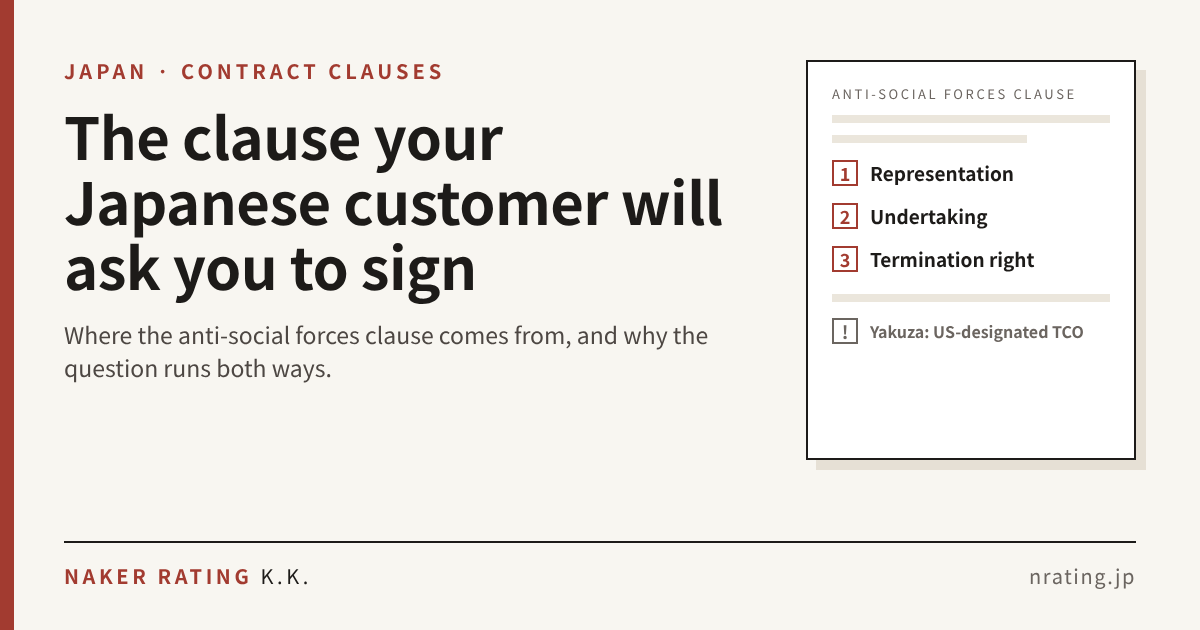
- 1Why customers ask2007 government guidelines and prefectural ordinances in force nationwide since 2011. Signing is normal and says nothing about you in particular
- 2What the clause containsTypically a representation, an undertaking and an immediate termination right
- 3The limitA representation is not verification. There is no public list to check, and organised crime groups operate through ordinary companies
- 4Sanctions angleThe Yakuza is a US-designated transnational criminal organisation, so screening is also a sanctions question
- 5How to screenBuild the picture from sanctions lists, Japanese-language media, registry history, court records and ownership
Sooner or later, a Japanese customer will send you a document you have not seen elsewhere: a clause, or a separate declaration, in which you confirm that your company, its officers and its shareholders have no connection with “anti-social forces”. If you refuse, or ask what it means, the deal may stall.
The request is standard in Japan, and it says nothing about you in particular. This article explains where it comes from, what you are actually signing, and why the same question matters when you are the one assessing a Japanese company.
Where the clause comes from
“Anti-social forces” (hanshakai-teki seiryoku) is the Japanese umbrella term for organised crime groups, known as boryokudan or yakuza, and the people and businesses around them.
In June 2007 the Japanese government’s ministerial meeting on crime countermeasures issued guidelines on how companies should protect themselves from anti-social forces. The guidelines set five principles, including cutting off all relationships, transactions included, and they ask companies to put clauses excluding organised crime into their contracts and terms of business.
Local law followed. Every prefecture had an organised crime exclusion ordinance in force by October 2011. Tokyo’s ordinance, for example, took effect on 1 October 2011 and asks businesses, where a contract might help an organised crime group, to make efforts to confirm that the other party, and anyone acting for it, is not connected with such a group, and to make efforts to include special terms to that effect in written contracts.
These are “efforts” duties rather than strict prohibitions, but many Japanese companies treat them as routine, which is why a Japanese customer may ask every new counterparty, foreign or domestic, to sign.
What you are signing
The wording varies, but the clause usually does three things:
- A representation. You confirm that your company, its officers and, often, its major shareholders are not, and have not recently been, connected with anti-social forces.
- An undertaking. You promise not to use threats, violence or similar conduct towards the other party.
- A termination right. If the representation turns out to be false, the other party can end the contract immediately, and usually without paying compensation.
For most foreign suppliers, signing is straightforward. Read it as you would any warranty: make sure it covers only what you can stand behind, and check whether it extends to agents or subcontractors you use in Japan.
The question runs both ways
The clause protects your Japanese customer from you. It does not protect you from your Japanese customer.
A representation from a Japanese company that it has no links to organised crime is worth having, but it is not verification. According to the National Police Agency, there were about 17,600 organised crime group members and associates in Japan at the end of 2025. That is far fewer than a decade ago, but groups have long operated through ordinary-looking companies, and those companies do not carry a label.
There is also a sanctions angle that many foreign firms miss. In July 2011 the President of the United States identified the Yakuza as a significant transnational criminal organisation under Executive Order 13581, and the US Treasury has since designated major groups, including the Yamaguchi-gumi and the Sumiyoshi-kai, and individual members. Designation freezes assets within US jurisdiction and prohibits transactions with them by US persons. If you are a US company, or deal in US dollars through US banks, a connection between your Japanese counterparty and a designated person is not only a reputational problem.
How to screen a Japanese counterparty
There is no public list of organised crime members or affiliated companies that you can search. Screening in Japan is therefore a matter of building a picture from several sources:
- Sanctions lists. Screen the company, its directors and any known owners against sanctions lists, including the US designations above. Keep the result, even when it is “no record found”.
- Japanese-language adverse media. Most reporting on organised crime links, arrests and police raids is in Japanese. A search in English will miss it.
- Registry history. Frequent changes of representative director, trade name, head office or business purpose, especially in a short period, deserve a question.
- Court and regulatory records. Litigation, administrative orders and exclusion from public tenders can all be relevant.
- Ownership. As we explained in our article on the Japanese registry, shareholders are not on the registry. Ask, and test the answer.
No outside investigator can tell you with certainty that a company has no link to organised crime. What a good investigation can do is show you the facts on record, flag the patterns that deserve questions, and document that you looked.
How we help
Naker Rating K.K. investigates Japanese companies for credit managers, trade-credit insurers and credit-reporting agencies outside Japan. Our English-language reports cover registry history, adverse records and Japanese-language adverse media, litigation, and sanctions and export-control screening of the company and its representative, alongside a five-grade credit rating (NRating), an estimated default probability and a credit limit (NR Credit Limit). Our sanctions screening, NRESS, checks names against several hundred sanctions, export-control and related lists, including US designations.
When a company publishes no accounts at all, our reports include NRMFS, our estimated financial statements, so you still have reference figures for the company’s size, net worth and leverage.
Download the sample pack (PDF) | Order a report by email | Ask about a Japanese company
Summary
- Japanese customers ask for anti-social forces clauses because of 2007 government guidelines and prefectural ordinances in force nationwide since 2011. Signing is normal.
- The clause typically contains a representation, an undertaking and an immediate termination right.
- A representation is not verification. There is no public list to check, and organised crime groups operate through ordinary companies.
- The Yakuza is a US-designated transnational criminal organisation, so screening is also a sanctions question.
- Build the picture from sanctions lists, Japanese-language media, registry history, court records and ownership.
Sources
- Guidelines for companies to prevent damage from anti-social forces (企業が反社会的勢力による被害を防止するための指針, 19 June 2007), as published by the Nagano Prefectural Police: https://www.pref.nagano.lg.jp/police/anshin/boutai/kigyou/shishin.html
- National Police Agency, White Paper on Police 2012, chapter on organised crime (ordinances in force in all prefectures by October 2011): https://www.npa.go.jp/hakusyo/h24/honbun/html/o3140000.html
- Tokyo Metropolitan Ordinance on the Exclusion of Organised Crime Groups, Article 18 (東京都暴力団排除条例): https://www.keishicho.metro.tokyo.lg.jp/kurashi/anzen/tsuiho/haijo_seitei/haijo_jourei.files/jourei.pdf
- Organised crime group membership at the end of 2025 (National Police Agency data, as reported by nippon.com): https://www.nippon.com/ja/japan-data/h02765/
- US Department of the Treasury, designation of the Sumiyoshi-kai under E.O. 13581 (27 September 2012), referring to the July 2011 identification of the Yakuza and the earlier designation of the Yamaguchi-gumi: https://home.treasury.gov/news/press-releases/tg1722
One thought on “Why your Japanese customer wants an “anti-social forces” clause, and how to screen Japanese counterparties”