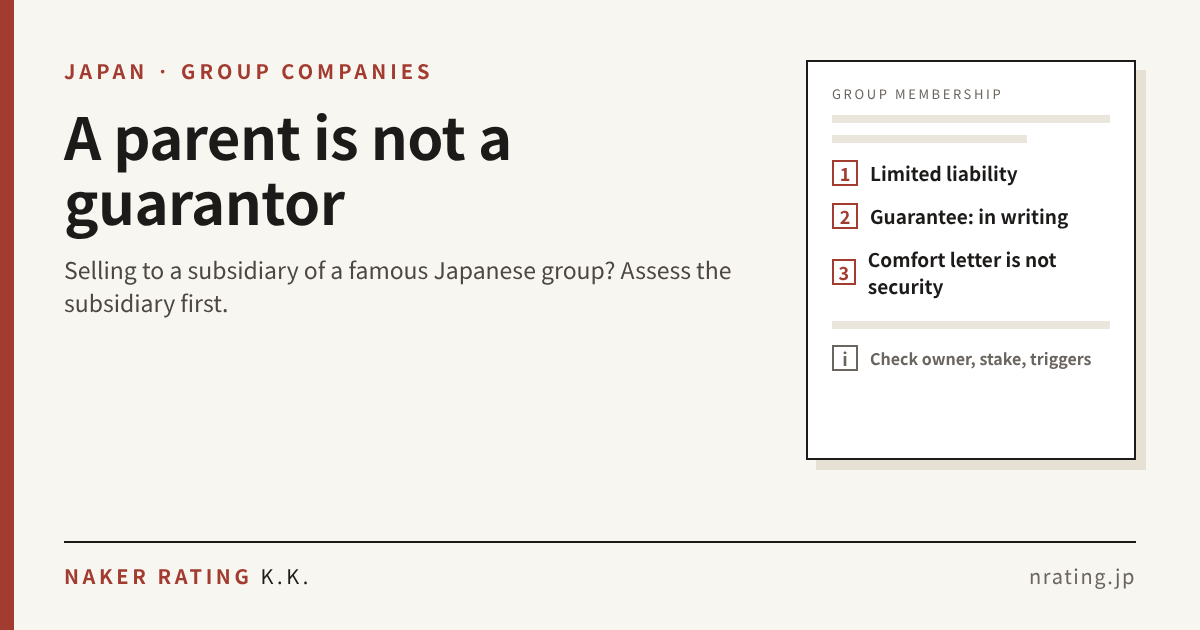
- 1In lawA shareholder’s liability is limited to what it paid for its shares. A parent is not liable for its subsidiary’s debts unless it agrees to be
- 2GuaranteesA guarantee must be in writing. A group name, a logo or a sales manager’s assurance is not one
- 3Comfort lettersOften drafted not to create a payment obligation. Read the wording
- 4Group supportReal but can change: parents sell, shareholdings fall, non-core businesses are let go
- 5What to doAssess the subsidiary on its own, then decide how much weight the parent deserves
A new customer writes from Japan. The company name is unfamiliar, but the e-mail signature, the website and the sales pitch all say the same thing: we are part of a famous Japanese group. For many credit teams outside Japan, that settles it. The parent is large, listed and well rated, so the subsidiary must be safe.
It is a reasonable instinct. It is also how a lot of unsecured credit is extended to companies that nobody has actually assessed. This article explains what group membership means in law, what it means in practice, and what to check before you rely on it.
In law, the parent does not pay
Japan, like most countries, gives shareholders limited liability. Under the Companies Act, a shareholder’s liability is limited to the amount it paid for its shares. A parent company is a shareholder. Unless it has agreed otherwise, it is not liable for its subsidiary’s debts, however large it is and however much of the subsidiary it owns.
That is true of a 100%-owned subsidiary as much as of a 51%-owned one. It is also true when the subsidiary carries the parent’s name, uses its logo and shares its head office.
A guarantee has to be in writing
If you want the parent to stand behind the subsidiary, the usual tool is a guarantee. Under Japan’s Civil Code, a guarantee contract has no effect unless it is made in writing, or in an electronic record that records its content.
In practice, that means a verbal assurance from the subsidiary’s sales manager, or a line on its website saying it is “a member of the X Group”, is not a guarantee. If the exposure matters, ask for a written guarantee from the parent, signed by someone authorised to give it. If the parent will not sign one, that tells you how it sees the relationship.
Comfort letters are not guarantees
Sometimes a parent offers something softer: a letter stating that it owns the subsidiary, that it intends to keep supporting it, or that it will “make efforts” to ensure the subsidiary meets its obligations. In Japan these are often called management-guidance letters (keiei shido nensho); elsewhere, letters of comfort or support.
Whether such a letter creates any legal obligation depends on its wording and the circumstances. Many are drafted precisely so that they do not create a payment obligation. Treat a comfort letter as useful information about the parent’s intentions, not as security, and have a lawyer read it before you extend credit on the strength of it.
What group membership does tell you
None of this means group membership is worthless. In practice, large Japanese groups often do support their subsidiaries, for reasons of reputation, banking relationships and business. A credit rating agency may even rate a subsidiary partly on the strength of its parent.
In our own Standard sample report, the subject is a listed company controlled by a much larger trading group, which holds just over half of its shares. The external rating agency stated that the subject’s rating reflects the creditworthiness of the group. That support is real and it is part of our assessment. But the report still rates the subject on its own balance sheet, cash flow and risks, and lists a change in the parent’s shareholding as one of the triggers for review.
That is the right way round: start from the subsidiary, then decide how much weight the parent deserves.
What can change
Group support is a business decision, and business decisions change. Things to watch:
- The parent sells. Japanese groups regularly restructure and sell non-core subsidiaries to other companies or to investment funds. The day after a sale, “a member of the X Group” is no longer true.
- The shareholding falls. A move from majority to minority ownership can change both the parent’s incentive to support and the way rating agencies treat the subsidiary.
- The subsidiary is non-core. Support is most reliable for businesses that matter to the parent. A small, loss-making subsidiary in a business the parent is leaving is the one most likely to be let go.
- The name stays, the owner changes. Companies sometimes keep a group name for a period after a change of ownership.
What to check
- Who actually owns the company, and how much? Shareholders are not on the Japanese registry, as we explained in our article on the registry. Ask, and check the parent’s own disclosure where it is listed.
- Is there a written guarantee? If not, assume there is no legal recourse to the parent.
- What does any comfort letter actually say? Read the wording, not the heading.
- Can the subsidiary pay on its own? Assess its accounts, or, where there are none, estimated figures; its payment record; and its litigation and adverse records.
- How important is it to the parent? Look at its size within the group, its business line and any announced restructuring.
- What would make you review the limit? Write down the triggers: a change of shareholder, a rating action on the parent, a restructuring announcement.
How we help
Naker Rating K.K. investigates Japanese companies, including subsidiaries of large groups, for credit managers, trade-credit insurers and credit-reporting agencies outside Japan. Our English-language reports set out the shareholding and group structure, assess the subsidiary on its own figures, and give a five-grade credit rating (NRating), an estimated default probability and a credit limit (NR Credit Limit), with watchpoints and review triggers. When a company publishes no accounts at all, our reports include NRMFS, our estimated financial statements, so you still have reference figures for its size, net worth and leverage.
Download the sample pack (PDF) | Order a report by email | Ask about a Japanese company
Summary
- Under Japanese law a shareholder’s liability is limited to what it paid for its shares. A parent is not liable for its subsidiary’s debts unless it agrees to be.
- A guarantee must be in writing. A group name, a logo or a sales manager’s assurance is not one.
- Comfort letters are often drafted not to create a payment obligation. Read the wording.
- Group support is real but can change: parents sell, shareholdings fall, non-core businesses are let go.
- Assess the subsidiary on its own, then decide how much weight the parent deserves.
Sources
- Companies Act, Article 104 (limited liability of shareholders) (会社法第104条): https://laws.e-gov.go.jp/law/417AC0000000086
- Civil Code, Article 446 (guarantee contracts must be in writing) (民法第446条): https://laws.e-gov.go.jp/law/129AC0000000089