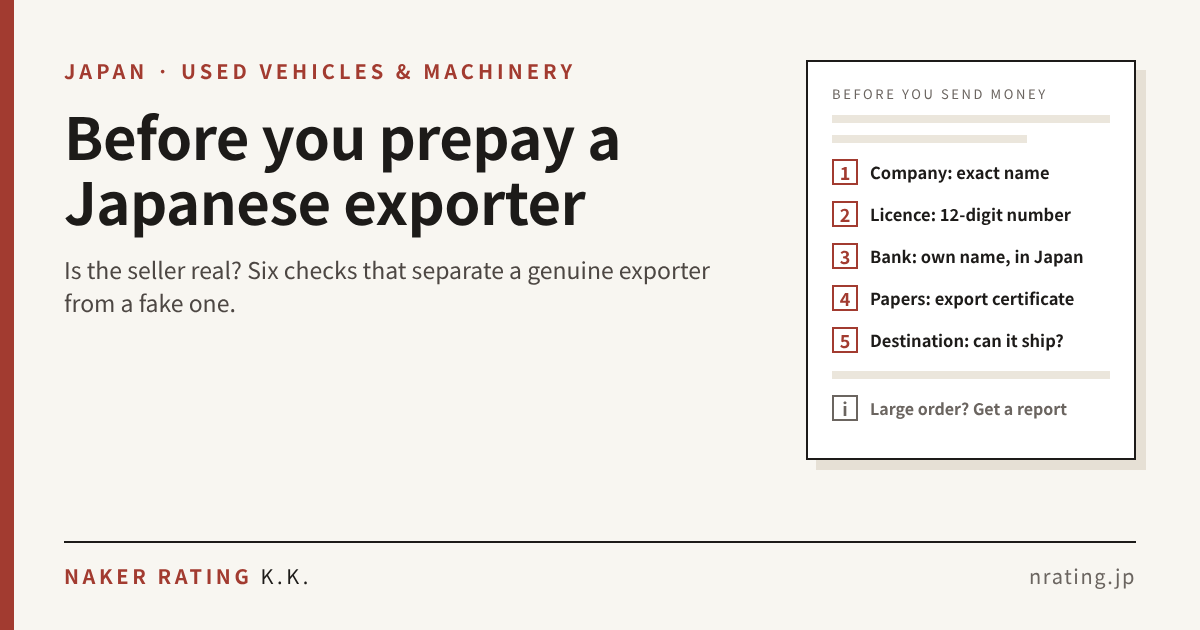
- 1Prepayment is your whole riskIf a Japanese exporter takes your money and does not ship, there is usually little to recover.
- 2Confirm the exact companyCheck the exact name and address on the Corporate Number Publication Site, and watch for impersonation of real companies.
- 3Look for the dealer licenceUsed-goods dealers need a licence with a 12-digit number. Dealers trading online are listed by the prefectural Public Safety Commission.
- 4Follow the moneyPay only into the company’s own account at a bank in Japan, and confirm any change of bank details by telephone.
- 5Ask for the papersA real exporter can show the export deregistration certificate and any pre-shipment inspection certificate.
- 6Check it can shipJapan bans some vehicle exports to Russia, and some machinery needs an export licence. A careful exporter will ask where the goods are going.
Japan exports used cars, trucks and machinery all over the world, and most of it is sold the same way: the buyer finds a vehicle online, agrees a price with an exporter in Japan and pays in advance. For an importer in Africa, the Middle East, Central Asia or the Pacific, that prepayment is the whole credit risk. If the exporter does not ship, there is usually little to recover.
Most Japanese exporters are genuine. But Japanese embassies in several countries have warned that some online advertisements for used cars are fraudulent, and that buyers who send money without checking the seller often cannot get it back. Fraudsters use Japan’s reputation, and sometimes the name and address of a real Japanese company.
This article sets out what you can check before you pay.
Check 1: does the company exist, under that exact name?
Every Japanese company has a 13-digit corporate number. The National Tax Agency’s Corporate Number Publication Site, which has an English interface, lets anyone confirm a company’s registered name, address and number, and the history of changes, free of charge. We described it in our article on the Japanese registry.
Compare what you find with the invoice, the website and the e-mail signature. A real company with a slightly different name, a different address, or a recent change of both is worth a question. Impersonation is common: the company exists, but the people you are dealing with are not part of it.
Check 2: is it licensed to deal in second-hand goods?
In Japan, a business that buys and sells second-hand goods, including used vehicles and machinery, needs a licence from the prefectural Public Safety Commission under the Antique Dealings Act. Each licence has a 12-digit number.
A licensed dealer that trades through a website must notify the Commission, and the Commission publishes a list of those dealers with their name, website address and licence number. If the website you are buying from is not on that list, ask why. The prefectural police point out that a listing is not a guarantee of honest trading, and that a newly notified site may take time to appear. Absence is a question; presence is not proof.
Check 3: is the exporter known to its industry?
The Japan Used Motor Vehicle Exporters Association (JUMVEA) publishes a list of its members and operates a “Safe Trade” system for buyers. Japanese embassies, including those in Tanzania and Rwanda, point buyers to it, while noting that they cannot guarantee each member. In Kenya, JETRO’s Nairobi office keeps a list of registered Japanese exporters and advises buyers to contact it before committing. Not every genuine exporter is a member, but membership is one more thing a fraudster cannot easily fake.
Check 4: where does the money go?
Most losses happen at the payment step. Warning signs include:
- A bank account in a third country, or in a personal name, for a company that says it is in Japan.
- A change of bank details by e-mail, especially just before payment. Confirm any change by telephone, using a number you found independently.
- Pressure to pay quickly because “another buyer is waiting”.
- A price well below the market for the same model and year.
The safest arrangement is a payment to an account in the company’s own name at a bank in Japan, or a payment method that protects the buyer.
Check 5: can the exporter show the vehicle’s papers?
A registered vehicle leaving Japan goes through export deregistration with the Ministry of Land, Infrastructure, Transport and Tourism, and the exporter receives an export deregistration certificate. Importing countries usually ask for it. Once it has been issued, a real exporter can show you a copy for your vehicle. Compare the vehicle details with your invoice, and be wary of an exporter who cannot produce it.
Many importing countries also require a pre-shipment inspection in Japan. The inspection certificate is another document a real exporter can produce.
Check 6: can it legally export to your country?
Japanese export rules apply to used goods too. Since 9 August 2023, Japan has banned exports to Russia of cars with engines over 1,900cc, hybrids, plug-in hybrids and electric vehicles. A Japanese exporter may ask where your vehicles are finally going, and a careful one will refuse an order that looks like a route around the ban. That is a sign of a legitimate business, not an obstacle.
The same applies to machinery. Some machine tools and industrial equipment need an export licence from the Ministry of Economy, Trade and Industry, used or not. Ask early whether a licence is needed, how long it will take, and who is responsible if it is refused.
A practical routine before you prepay
- Confirm the company on the Corporate Number Publication Site, under the exact name and address on your invoice.
- Find the licence: the 12-digit Antique Dealer licence number, and the website’s entry on the Public Safety Commission’s list.
- Check industry membership and, where available, local lists of registered exporters.
- Check the bank account: the company’s own name, at a bank in Japan. Confirm any change of details by telephone.
- Ask for the vehicle’s papers: the export deregistration certificate and any pre-shipment inspection certificate.
- For larger orders, get an independent report on the exporter before you pay.
How we help
Naker Rating K.K. investigates Japanese companies for buyers, credit managers, trade-credit insurers and credit-reporting agencies outside Japan. Our English-language reports confirm a company’s registration, address and representative, record its history of name and address changes, and check litigation and adverse records, with sanctions and export-control screening. Each report gives a five-grade credit rating (NRating), an estimated default probability and a credit limit (NR Credit Limit). When a company publishes no accounts at all, our reports include NRMFS, our estimated financial statements, so you still have reference figures for its size, net worth and leverage.
You can see two actual reports, de-identified, in our sample pack.
Download the sample pack (PDF) | Order a report by email | Ask about a Japanese company
Summary
- When you prepay a Japanese exporter, the prepayment is your whole credit risk.
- Confirm the company under its exact name and address, and watch for impersonation of real companies.
- A used-goods dealer needs a licence with a 12-digit number. Dealers trading online are listed by the prefectural Public Safety Commission.
- Pay only into the company’s own account at a bank in Japan, and confirm any change of bank details by telephone.
- Ask for the export deregistration certificate, and expect a legitimate exporter to ask where your goods are going.
Sources
- National Tax Agency, Corporate Number Publication Site (English): https://www.houjin-bangou.nta.go.jp/en/
- Aichi Prefectural Police, list of second-hand dealers trading through websites, under Article 8-2 of the Antique Dealings Act (ホームページを利用して取引を行う古物商): https://www.pref.aichi.jp/police/koan/kobutu/index.html
- Embassy of Japan in Tanzania, Important Notice on Online Purchase of Used Cars (28 February 2022): https://www.tz.emb-japan.go.jp/itpr_en/caution_second-hand-vehicles.html
- Embassy of Japan in Rwanda, Important Notice on Online Purchase and Importing of Used Cars (5 January 2023): https://www.rw.emb-japan.go.jp/itpr_ja/11_000001_00393.html
- Tohoku District Transport Bureau, export deregistration (輸出抹消仮登録): https://wwwtb.mlit.go.jp/tohoku/mg/tr/sub02_01_04_03.html
- Ministry of Economy, Trade and Industry, additional export bans on Russia from 9 August 2023 (対ロシア輸出禁止措置の拡大): https://www.meti.go.jp/press/2023/07/20230728001/20230728001.html