- 1ListsJapanese companies rarely appear on sanctions lists, but some do. Some lists cannot catch a Japanese company at all
- 2OwnershipUnder the US 50 Percent Rule, ownership by blocked persons matters even when the company is not listed. A similar export-control rule is suspended until 10 January 2027
- 3ShareholdersNot on the Japanese registry, and the beneficial owner list is voluntary. Ask
- 4Directors and namesDirectors appear only as names. Screen every romanised spelling, and record why each partial match was cleared
- 5Re-screenAt each review and before significant shipments
Most foreign suppliers run their Japanese customers through a sanctions screen, and almost all of them come back clean. Japan is a close ally of the United States and the European Union, with its own sanctions and export-control regime. A “no hit” therefore feels final.
It usually is, for the company name. But sanctions and export-control exposure rarely sits in the company name alone. It sits in who owns the company, who runs it, what it buys and where it sells. And with Japanese counterparties, how the name is spelt matters more than most screening teams expect.
Japanese companies do appear on lists
Japanese entries are rare, but they exist. The US Entity List has a country heading for Japan: in February 2024, for example, the Bureau of Industry and Security added an entry under Japan in a rule covering companies in seven countries. The US Treasury has also designated Japanese organised crime groups and individual members, as we described in our article on anti-social forces clauses.
Some lists cannot produce a Japanese hit at all. Japan’s own End User List, published by the Ministry of Economy, Trade and Industry, covers foreign end users of concern, not Japanese companies. A clean result against it tells you nothing about a Japanese counterparty. Know which lists can actually catch the company you are screening.
Ownership is where the exposure sits
Under the US Treasury’s 50 Percent Rule, an entity owned 50% or more, directly or indirectly, by one or more blocked persons is itself treated as blocked, even if it is not named on any list. Holdings of different blocked persons are added together. The rule looks at ownership, not control.
US export controls are moving in the same direction. In September 2025 the Bureau of Industry and Security issued a rule extending Entity List restrictions to companies 50% or more owned by listed parties. It was suspended for one year in November 2025, and on 9 November 2026 the suspension was extended through 10 January 2027. If it takes effect, a Japanese subsidiary of a listed foreign group could fall within US licence requirements without its own name appearing anywhere.
The difficulty in Japan is finding the owners. As we explained in our article on the Japanese registry, shareholders do not appear on the company registry. Since 31 January 2022, a stock company can lodge a list of its beneficial owners with the registry office, but the scheme is voluntary and copies are issued at the company’s own request. Listed companies disclose their major shareholders. For a private company, you have to ask.
Directors: on the registry, but only as names
Directors do appear on the Japanese registry, but only as names. There are no dates of birth, and since October 2024 a representative director’s home address can be shown only down to the city or ward. Screening a Japanese director therefore means matching on a name, often a common one, with little to confirm or rule out a match.
Japanese names on Western lists
Sanctions lists are published in Latin script. The Japanese registry is in Japanese. Between the two sits romanisation, and it is not consistent: the same surname can appear as Ono, Ohno or Oono, and the same company as Kabushiki Kaisha, K.K., Co., Ltd., or an English trade name that differs from its registered name.
This cuts both ways. Screen only one spelling and you may miss a match. Screen loosely and you will get false positives, because short Japanese name elements often appear inside unrelated names on the lists. In one of our sample reports, the representative’s surname appears as part of the names of unrelated individuals on US, EU and UN lists. Each match was examined, cleared and recorded, so the next review does not have to start again.
What the company trades
Being a Japanese company does not take a business outside US export controls. Items made in the United States, or containing controlled US content, remain subject to them when they are resold from Japan. If your Japanese counterparty is a trading company or distributor, the question is not only who it is, but where your goods go next.
A practical routine
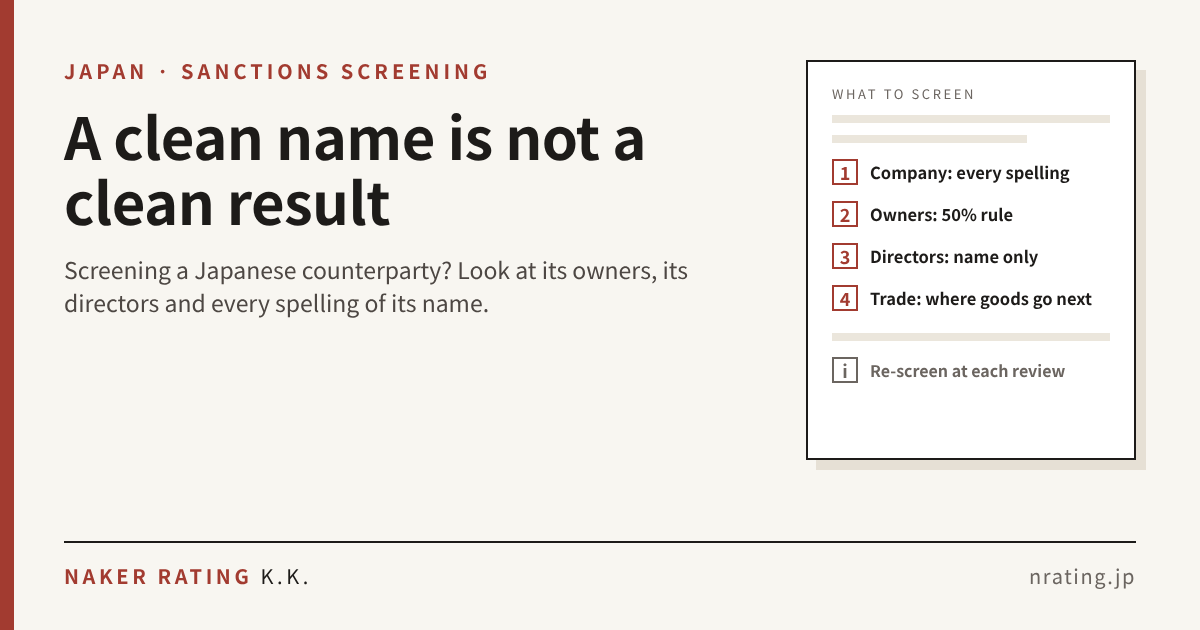
- Screen every form of the name: the registered Japanese name, its romanised form and any English trade name.
- Find the owners. Use disclosures for listed companies. For private ones, ask for the shareholder list or a copy of the beneficial owner list.
- Screen significant owners, and add up the holdings of any listed persons.
- Screen the representative director and other directors, and record why each partial match was cleared.
- Ask about destinations and end users when your goods are controlled or likely to be re-exported.
- Re-screen. Lists change several times a month. Screen again at each review and before significant shipments.
How we help
Naker Rating K.K. investigates Japanese companies for credit managers, trade-credit insurers and credit-reporting agencies outside Japan. Our English-language reports set out the shareholding and group structure where it can be established, and include an economic-security section that screens the company and its representative against sanctions and export-control lists, with partial matches examined and recorded. Our screening, NRESS, checks names against several hundred sanctions, export-control and related lists, including Japanese and US lists. Screening of shareholders and other directors is available as an additional service; tell us when you order.
Each report also gives a five-grade credit rating (NRating), an estimated default probability and a credit limit (NR Credit Limit). When a company publishes no accounts at all, our reports include NRMFS, our estimated financial statements, so you still have reference figures for its size, net worth and leverage.
You can see two actual reports, de-identified, in our sample pack.
Download the sample pack (PDF) | Order a report by email | Ask about a Japanese company
Summary
- Japanese companies rarely appear on sanctions lists, but some do, and some lists cannot catch a Japanese company at all.
- Under the US 50 Percent Rule, ownership by blocked persons matters even when the company is not listed. A similar export-control rule is suspended until 10 January 2027.
- Japanese shareholders are not on the registry, and the beneficial owner list is voluntary. Ask.
- Directors appear only as names. Screen every romanised spelling, and record why each partial match was cleared.
- Re-screen at each review and before significant shipments.
Sources
- US Department of the Treasury, OFAC, FAQs on entities owned by blocked persons (50 Percent Rule): https://ofac.treasury.gov/faqs/topic/1521
- Bureau of Industry and Security, extension of the suspension of the Affiliates Rule through 10 January 2027 (Federal Register, 9 November 2026, FR Doc. 2026-22793): https://www.federalregister.gov/documents/2026/11/09/2026-22793/extension-of-the-suspension-of-expansion-of-end-user-controls-for-affiliates-of-certain-listed
- Bureau of Industry and Security, additions to the Entity List including an entry under Japan (Federal Register, 27 February 2024, FR Doc. 2024-03969): https://www.govinfo.gov/content/pkg/FR-2024-02-27/pdf/2024-03969.pdf
- Ministry of Justice (Tokyo Legal Affairs Bureau), beneficial owner list system from 31 January 2022 (実質的支配者リスト制度): https://houmukyoku.moj.go.jp/tokyo/page000001_00511.html